From honorifics that span many levels of politeness, to three different writing systems…for learners of Japanese, it may feel like the more you learn, the less you know. Although there has been great progress in translation technology, the language barrier remains a challenge that affects interactions between foreign and Japanese residents. Fortunately, there is growing recognition within local governments to apply a different approach: Yasashii Nihongo, or “Easy (Plain) Japanese.” The word ‘yasashi’ means both “easy” and “kind”, reflecting a style of communication that is simplified and empathetic. There are two ways to use Yasashii Nihongo, in written and spoken forms and today, I will be focusing on the spoken application.
Yasashii Nihongo developed following the 1995 Great Hanshin-Awaji Earthquake, as many foreign residents struggled to understand the emergency information that was given in complex Japanese or English. In response, Professor Kazuyuki Sato from Hirosaki University created a simplified version of Japanese to ensure that information is available to those with basic Japanese skills. Yasashii Nihongo isn’t only for non-Japanese residents and benefits the elderly as well as people with cognitive decline.
Here’s a graphic of the languages that the foreign population of Ichinoseki understand:
As you can see, Japanese is the most understood language, and English comes in second.
Japanese natives are often surprised by this; many were raised thinking they should communicate in English when they met someone who isn’t Japanese. A large proportion of Japan’s foreign nationals are from neighboring Asian countries and find simplified Japanese easier to navigate than English.
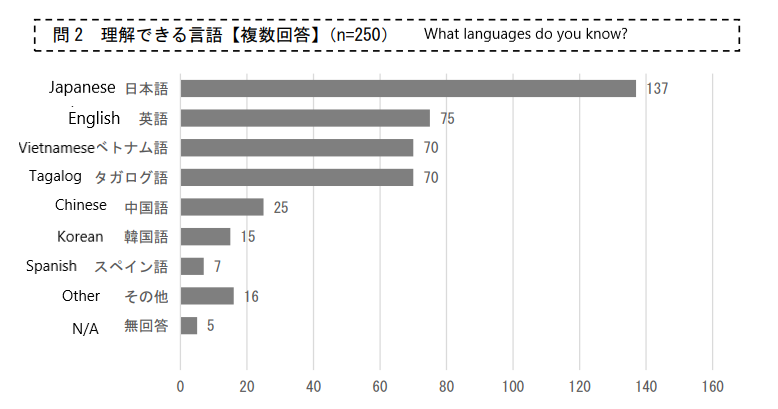
<2022 Ichinoseki City Survey Report on Foreign Residents(Pg: 2)>
Some ways to simplify Japanese:
- Short, non-complex sentences
- Speak slowly and clearly
- Honorific expressions should be avoided
- Don’t use vague expressions
Don’t use onomatopoeia
And some ways that Japanese can be kinder
1) Adjusting language level
2) Actively listening and checking for understanding
3) Understanding there could be cultural gaps in knowledge

Sounds good in theory, but is it really that effective?
As someone who came to Japan with advanced Japanese skills, it was hard to assess how useful Yasashii Nihongo really is. Sure, I had seen the statistics, but it wasn’t until recently, when I had the opportunity to conduct a Yasashii Nihongo workshop for library staff of Ichinoseki City that I could see it working firsthand.
Most of the library staff lacked prior knowledge of Yasashii Nihongo, but following a 30-minute presentation, they began testing it with volunteers from Nigeria and Indonesia at a beginner to intermediate level in Japanese. Initially, the volunteers were unable to grasp most of the standard Japanese expressions that were presented to them. Following efforts to reorganize vocabulary and sentence structure, the participants who self-reported understanding 0 –30% of the initial texts, claimed they grasped 70% –100%. It was exciting to watch both sides light up when understanding was achieved.
Looking ahead, areas of implementation in real life situations was an area of uncertainty within the staff. Not knowing the Japanese proficiency of a person that comes to the counter and how to adjust/grade their language in response. “What if they feel it’s rude to talk to them in simple terms when they can in fact understand fluent Japanese?”, and on the flipside, “What if I speak regular Japanese to them and they get disheartened and walk away because of the level being too difficult?”.
These are some empathetic questions that I’d like to tackle the next time I run a Yasashi Nihongo workshop, drawing on ongoing introspection and practice.

Having observed Yasashii Nihongo in action, it is clear to me that it’s a highly effective tool. Although Yasashii Nihongo isn’t perfect, nor the only tool for communicating with foreign residents, there’s no doubt that it opens a window of opportunity for better connection. After a short 30-minute seminar, staff members could adapt their own communication style and start interacting with international residents, rather than having to learn a whole new language or rely only on translation apps. However, its thoughtful application is necessary. And importantly, it’s a mutual effort: while foreign residents work to learn a new language, local residents are encouraged to adjust their own language use for effective communication.
With the number of foreign workers in Ichinoseki gradually increasing, tools like Yasashii Nihongo support integration. As part of the Kitakami Site, a candidate location for the International Linear Collider, Ichinoseki is actively learning how to become a city that promotes multicultural coexistence.
Japanese
やさしい日本語:多文化共生のためのツール日本語学習者にとって、日本語は複雑な敬語や三つの異なる文字体系を前にすると、学べば学ぶほど分からなくなるように感じることがあります。言語の壁は、翻訳技術の進歩にもかかわらず、外国人住民だけでなく日本人にも影響を与えます。幸いなことに、地方自治体の間では別のアプローチを取り入れる動きが広がっています。それが「やさしい日本語(Yasashii Nihongo)」です。
やさしいという言葉には「簡単」と「親切」の二つの意味があり、簡潔で思いやりのあるコミュニケーションスタイルを示しています。やさしい日本語は、書き言葉と話し言葉の両方で使うことができますが、今日は話し言葉の応用に焦点を当てます。
やさしい日本語は、1995年の阪神・淡路大震災をきっかけに生まれました。当時、多くの外国人住民が、複雑な日本語や英語で提供される緊急情報を理解することに苦労していました。これを受けて、弘前大学の佐藤和之教授が、基礎的な日本語能力を持つ人々でも情報を理解できるよう、簡易化された日本語を作り出しました。やさしい日本語は外国人住民だけでなく、高齢者や認知症の方にも役立ちます。
以下は一関市の在住外国人が理解できる言語のグラフ:ご覧の通り、日本語が最も多く理解されている言語、次いで英語です。日本人はこれに驚くことがあります。多くの日本人は、外国人と出会った際には英語で話すべきだと育ってきたためです。
日本の外国人住民の多くは、アジア諸国出身であり、英語よりも簡単な日本語の方が理解しやすいと感じています。
日本語を簡単にする方法
1. 短くて分かりやすい文章にする
2. ゆっくり、はっきり話す
3. 敬語は避ける
4. 曖昧な表現は使わない
5. 擬音語・擬態語は避ける
日本語をより親切にする方法
1. 相手のレベルに合わせて言葉を調整する
2. 積極的に聞き、理解を確認する
3. 文化的な知識の差がある可能性を理解する
理論上は良さそうですが、実際にはどのくらい効果的でしょうか。私は日本語が上級レベルで日本に来たため、やさしい日本語の効果を評価するのは難しかったです。統計を見たことはありましたが、最近一関市の図書館職員を対象にやさしい日本語ワークショップを実施する機会があり、初めてその効果を実感できました。一関市の図書館職員の大半はやさしい日本語の知識がありませんでしたが、30分の説明の後、図書館職員は日本語初級〜中級レベルの外国人ボランティアと交流しました。最初は、外国人ボランティアは提示された標準的な日本語表現のほとんどを理解できませんでした。しかし、語彙や文章構造を整理したところ、最初は0〜30%しか理解できなかったボランティアの方々が、70〜100%理解できると答えました。理解が達成された瞬間、両者の表情が明るくなるのを見るのは非常に印象的でした。今後の課題は、現実の場面でどのように実践するかという点です。窓口に来た人の日本語能力を把握し、適切な言葉で対応することは簡単ではありません。「相手が流暢な日本語を理解できるのに、簡単な日本語で話すと失礼に感じるのでは?」あるいは逆に、「通常の日本語で話したら難しすぎて落胆し、帰られてしまうのでは?」といった疑問が生まれます。これらは、次回のワークショップで取り組みたい共感的な課題であり、継続的な振り返り、実践から学んでいきたいです。
やさしい日本語を実際に観察してみて、その有用性は明らかでした。やさしい日本語は完璧ではなく、外国人住民とコミュニケーションを取る唯一の手段ではありませんが、確実により良いコミュニケーションの機会となります。30分程度の短いセミナーの後、職員は自身のコミュニケーションスタイルを適応させ、さまざまな外国人住民と交流ができます。全ての場面で慎重な応用が必要ですが、この取り組みは双方向的です。外国人住民は新しい言語を学ぶ努力をしており、日本人もより効果的に伝わるようにコミュニケーションスタイルを適応させることが求められます。
一関市では外国人労働者の数が徐々に増えており、やさしい日本語は円滑な交流を支援する重要なツールとなっています。また、一関市は国際リニアコライダー(ILC)の候補地である北上サイトの一部として、多文化共生を促進する街づくりを積極的に学んでいます。