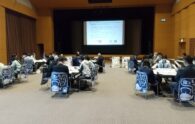
This spring, high school students from Iwate Prefecture visited Japan’s premier world-class research facilities.
Their destinations were the Japan Proton Accelerator Research Complex (J-PARC), which generates neutron, muon, neutrino, and K meson beams; Super-Kamiokande, an observatory that studies and investigates the behavior of the neutrinos emitted by J-PARC; and the Kamioka Liquid Scintillator Antineutrino Detector (KamLAND), where analysis of reactor neutrinos and other particles is conducted. All three are globally renowned top-level research facilities working to solve the mysteries of matter and the universe.
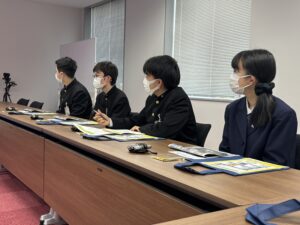
The participants of this trip were the four members of the team that placed first in the Iwate High School Science and Engineering Challenge Contest, previously covered in THE KITAKAMI TIMES No. 218.
Over the next few articles, we’ll be focusing on these Iwate high schoolers who passed the contest’s trial by fire and watching how they learn from each of these research facilities. For this first issue, let’s check out their tour of J-PARC.
- Japan Proton Accelerator Research Complex (J-PARC)
J-PARC is located in Tokai, Ibaraki Prefecture, which is northeast of Tokyo. It takes around 5 hours to get there from Morioka in Iwate Prefecture, transferring between the shinkansen and local trains.
J-PARC uses high-intensity proton beams to generate a diverse variety of secondary beams, such as neutron, muon, neutrino, and K meson, which are then shared with users around the world. The facility drives a wide range of research and development projects—everything from basic scientific study to industrial applications.
After arriving at the facility, the students received a lecture from Prof. Takashi Kobayashi, director of the J-PARC Center. At first, they seemed slightly nervous, but as the affable director spoke about some of the facility’s unique achievements, such as analyses of stones found in asteroids and the nondestructive identification of the contents in Koan Ogata’s sealed medicine bottles, they felt his powerful passion for J-PARC and came to understand just how advanced its research is.
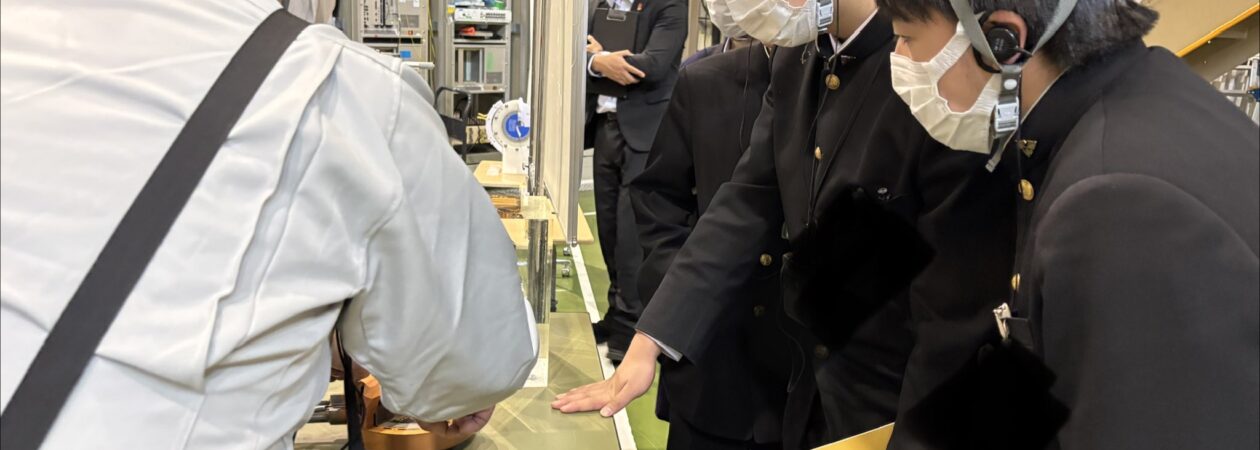
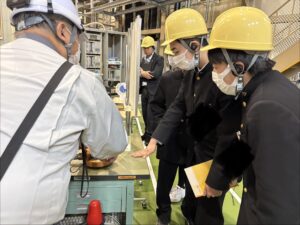
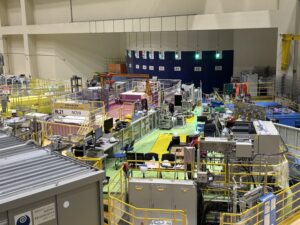
After the lecture came the tour of the linear accelerator (Linac) building, which houses the spectacular 330-meter-long klystron gallery. The students enthusiastically asked questions about the metal magnetic cores that enable the facility’s high particle acceleration gradient, and learned about how electromagnets and high frequency apparatuses are used to amplify acceleration and energy. They were impressed by the scientists’ idea to start using high frequency technology in this way.
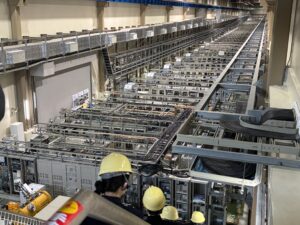
left:The klystron gallery
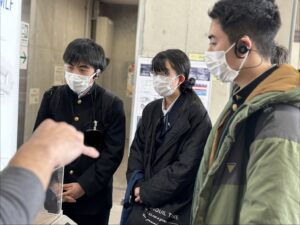
right:Students touching the machinery with their own hands
The students then snuck into the Neutrino Experimental Facility, where several quadrillion neutrinos are produced each day. Here too, they were fascinated to learn that neutrinos follow different paths from other particles due to being electrically neutral. They continued to deepen their knowledge by studying the graphite targets utilized in the generation of neutrino beams for the currently ongoing T2K experiment (conducted jointly with Super-Kamiokande in Gifu Prefecture).
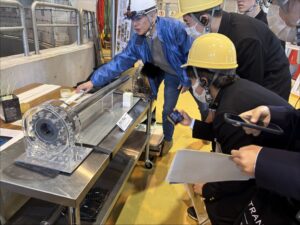
Students listening to an explanation of the graphite target
Next up was the Hadron Experimental Facility. In this supermassive building, research is conducted on extremely tiny elementary particles and atomic nuclei. A researcher explained that while this work isn’t useful right now, it will be 100 years in the future, and the students found it highly intriguing to think that mankind’s knowledge has not yet evolved enough to make full use of the research being conducted right before their eyes.
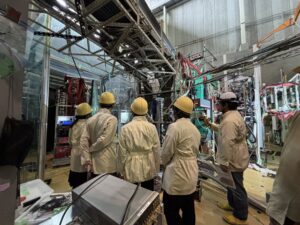
Lastly, they visited the Materials and Life Science Experimental Facility. This is none other than the place where the research Director Kobayashi talked about – the analyses of stones in asteroids and the nondestructive identification of the contents in Koan Ogata’s sealed medicine bottles – was made possible. Upon hearing that the technology developed in this facility has been utilized in applications such as restoring data on computers, the students remarked that it seems to have a wide range of uses from everyday life to specialized fields, and they look forward to future developments.
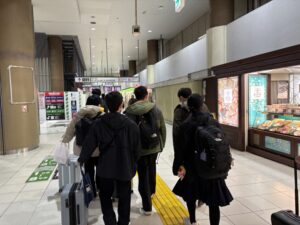
After leaving J-PARC, the students departed from Tokai and made their way to Kamioka in Hida, Gifu Prefecture. By the end of another 5 hour journey on buses and the shinkansen, everyone wished they could arrive in an instant just like the neutrinos in the T2K experiment…
In the next issue, we’re following the students and neutrinos to Kamioka, where we’ll report on the study tour at KamLAND!
Japanese
【いわての高校生、世界最先端研究施設に潜入!~教科書のその先へ~ J-PARC編】この春、岩手県内の高校生たちが、日本が誇る世界最先端の研究施設を訪れました。
訪問先は、中性子やミュオン、ニュートリノ、K中間子などのビームを生成している「大強度陽子加速器施設(J-PARC)」と、J-PARCから放たれるニュートリノを受け止めて性質を解明する「スーパーカミオカンデ」、原子炉ニュートリノなどの解析を行う「カムランド」で、どれも宇宙や物質の謎に挑む世界最高レベルの研究施設です。
この研修に参加したのは、THE KITAKAMI TIMES第218号でお伝えした、「いわての高校生サイエンス&エンジニアリングチャレンジコンテスト」で第1位に輝いたチームの4名。
今回は、コンテストの激戦をくぐり抜けたいわての高校生たちが、これらの研究施設で学んでいく様子を紹介します。第1回は、J-PARCでの見学の様子です。
●大強度陽子加速器施設(J-PARC=Japan Proton Accelerator Research Complex)
J-PARCは、日本の東京の北東にある茨城県東海村にあります。岩手県盛岡市からは、新幹線や列車を乗り継いで、5時間程度で到着します。
このJ-PARCでは、大強度陽子ビームを用いて生成される中性子やミュオン、ニュートリノ、K中間子といた多彩なビームを国内外の利用者に提供し、基礎科学から産業応用まで多様な研究開発を推進しています。
施設到着後、小林隆センター長から直々にレクチャーをいただいた生徒たちは少し緊張気味。親しみやすいセンター長からは、小惑星にある石の解析や、昔の「開かずの薬瓶」の中身を壊さずに解明したことなどのユニークな実績が紹介され、J-PARCのレベルの高さ、センター長のJ-PARCにかける想いがパワフルに伝わってきました。
その後は、長さ330メートルの圧巻のクライストロンギャラリーがあるリニアック棟(Linac)を見学。生徒たちは高い高速勾配を実現する「金属磁性体コア」について、熱心に見学し質問していました。電磁石や高周波装置で加速とエネルギーの増幅を行っていることについて「高周波を使う発想の転換がすごい」と生徒たち。
続いてのニュートリノ研究施設(Neutrino to Super-Kamiokande)では、毎日数千兆個のニュートリノが生成されている現場に潜入しました。ここでも生徒たちは、ニュートリノが中性であるがゆえに他の粒子とは異なる軌跡を示すことに興味深々。現在進行中のT2K実験(岐阜県のスーパーカミオカンデとの共同実験)でニュートリノビームの生成に用いられている黒鉛の標的を観察するなどして、知識を深めました。
続いてはハドロン実験施設(Hadron Experimental Facility)です。超巨大な建屋内で、ごくごく小さな素粒子や原子核に関する研究が行われています。「今すぐには役に立たないが、100年後の未来に役立つ研究をしている」との研究者の言葉に、生徒たちは「今目の前で見ているこの研究の先に人類の叡智の進歩があると思うととても面白い」と未来に思いを馳せていました。
最後は、物質・生命科学実験施設(Materials and Life Science Experimental Facility)を見学。ここはまさしく、小林センター長から話のあった「小惑星の石の解析」や「薬瓶の中身の非破壊解析」を可能とした舞台です。ここで生まれる技術を応用すると、パソコンの情報復元などにも役にたつとのことで、生徒からは「日常の場面から専門的な場面まで広く活躍できそうで今後の発展がとても楽しみ」といった感想を聞くことができました。
このあと生徒たちは、バスや新幹線を乗り継いで、東海村から岐阜県飛騨市神岡町まで通算5時間以上かけて移動しました。T2K実験のニュートリノのように一瞬で到着できればいいのに…と誰しもが思ったのでした……
次回はニュートリノを追いかけた先の神岡町での研修の様子をレポートします!